
The Chebyshev Collocation Method in GAUSS
| Discrete Ramsey Growth Model: Example 1 | ||
 |  |
Continuous Lucas Endogeneous Growth Model: Example 2 |
| |
Stochastic Growth Model: Example 3 |
 |
The library unit
PROJEC for GAUSS |

The Chebyshev collocation method, a member of the family of projection methods, is one of the most efficient tools for the numerical solution of intertemporal optimizing economic models with infinitely living representative agent (see "How to Solve Growth Models: A User's Guide to the Collocation Method in GAUSS" CERGE-EI Discussion Paper 2000-39, September 2000).
The algorithm of this method is as following. The first order conditions for an optimal control problem lead to a system of difference/differential equations or, more generally, functional equations with respect to unknown policy functions. These policy functions can be then approximated by Chebyshev polynomials with unknown coefficients. Thus, the problem of solving a system of difference/differential equations is transformed into a much simpler problem of solving a system of nonlinear algebraic equations. The latter can be solved by any nonlinear equation method, like Newton method.
The procedure PROJEC returns the approximation parameters and an indicator of whether method has converged.
Discrete Ramsey Growth Model: Example 1
| |
Gauss program using the PROJEC library unit (RamseyCode2, RamseyCode6) |
| |
Computed parameters of approximation (RamseyPar2, RamseyPar6) |
|
Residuals and Transition Path (RamseyRes2, RamseyRes6) |
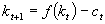
This example deals with a discrete deterministic growth problem: to find a path of consumption ct which maximazes

and where capital, which is state variable, obeys the law of motion
 .
.
From the Euler equation, by introducing the optimal policy function as c = p(k) we can get
 .
.
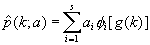
After specifying the domain of the approximation [k1,k2] including the steady state value of capital, the policy approximation to p is parametrically given by
 ,
,
where  is the ith
Chebyshev
polynom,
is the ith
Chebyshev
polynom, 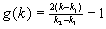 is a linear
transformation of the interval [k1,k2]
into [-1,1],
and s is the degree of approximation. Therefore, the residual
function becomes
is a linear
transformation of the interval [k1,k2]
into [-1,1],
and s is the degree of approximation. Therefore, the residual
function becomes
 .
.
Further, we specify functional forms for the utility and production function as the CRRA utility function and the Cobb-Douglas production function
 .
.
The residual function thus takes the form
 .
.
Then, the file RamseyCode2 for the computation of the approximation of optimal policy function c = p(k) in this economy, which uses the PROJEC library unit, is written in GAUSS (if the degree of aproximation = 2); or RamseyCode6 (if the degree of aproximation = 6). The program run will deliver the output RamseyPar2 (or RamseyPar6). The file RamseySim2 written in GAUSS will compute the residual function and transition path for capital stock; and RamseyPar6 will compute the residual function and transition path.
Continuous Lucas Endogeneous Growth Model: Example 2
| Gauss program using the PROJEC library unit (LucasCode2, LucasCode10) | ||
| |
Computed parameters of approximation (LucasPar2, LucasPar10) |
| |
Residuals and Transition Path (LucasRes2, LucasRes10) |
This example demonstrates the application of the projection method to continuous deterministic growth models.
In this model we want to find the path of consumption ct and the time devoted to work ut which maximize
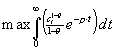
where physical and human capital are given by the following equations, respectively
 ,
,
where  and
and  are
parameters of the Cobb-Douglas production function,
are
parameters of the Cobb-Douglas production function,  is
depreciation rate of physical capital,
is
depreciation rate of physical capital,  indicates effectiveness of
education and
indicates effectiveness of
education and  is intertemporal elasticity of
substitution.
is intertemporal elasticity of
substitution.
After deriving the necessary conditions
we get the
differential equations describing the evolution of the control
variables. It can be shown
that most of the variable exhibit sustained growth along the balanced
path. Therefore, the
model has to be transformed into a reduced form with zero steady state
growth rate of
transformed variables. For this purpuse, we can transform the initial
variables into two
control-like variables  and
one state-like variable
and
one state-like variable  .
.
The first order conditions may be rewritten as
 ,
,
 ,
,
where  are policy functions. The
approximations are given by
are policy functions. The
approximations are given by
 ,
,
where is the ith
Chebyshev polynom, 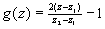 is a linear transformation of
the interval [z1,z2] into [-1,1],
and s
is the degree of approximation.
is a linear transformation of
the interval [z1,z2] into [-1,1],
and s
is the degree of approximation.
The residual functions are obtained by substituting the approximations into the first order conditions.
Then, the file LucasCode2 for the computation of the
approximation of optimal policy functions  in this economy, which uses the
PROJEC library unit, is written in GAUSS (if the degree of
aproximation = 2); or LucasCode10 (if the degree of
aproximation = 10). The program run will deliver
the output LucasPar2 (or LucasPar10). The file LucasSim2 written in
GAUSS will compute the residual function and
transition path for capital stock; and LucasPar10 will compute the residual function and transition path.
in this economy, which uses the
PROJEC library unit, is written in GAUSS (if the degree of
aproximation = 2); or LucasCode10 (if the degree of
aproximation = 10). The program run will deliver
the output LucasPar2 (or LucasPar10). The file LucasSim2 written in
GAUSS will compute the residual function and
transition path for capital stock; and LucasPar10 will compute the residual function and transition path.
Stochastic Growth Model: Example 3
| Gauss program using the PROJEC library unit (StochRamseyCode22, StochRamseyCode54) | ||
| |
Computed parameters of approximation (StochRamseyPar22, StochRamseyPar54) |
| |
Residuals and Transition Path (StochRamseyRes22, StochRamseyRes54) |
This example demonstrates the extension of the application of the projection method to continuous stochastic growth models.